
Time & Place
- Time: 1491 BC
- Location: Egypt (primarily Pharaoh’s court)
- Setting: Moses and Aaron confront Pharaoh; Israel remains in bondage (Exod 5–7)
Where Are We in the Text?
- Moses delivers God’s demand to Pharaoh and Israel’s conditions worsen (Exod 5)
- God reaffirms His covenant name and purpose to Moses (Exod 6:1–8)
- The genealogical identification of Moses and Aaron is recorded (Exod 6:14–27)
- Moses and Aaron are recommissioned and sent again to Pharaoh (Exod 6:28–7:7)
- The initial sign before Pharaoh is given (Exod 7:8–13)
Where Are We in Time?
- These chapters occur immediately following Moses’ return to Egypt at age eighty (Exod 7:7; Acts 7:30).
- Only days to weeks have passed since the initial confrontation with Pharaoh.
- This period marks the formal beginning of God’s direct intervention in Egypt (Exod 6:1).
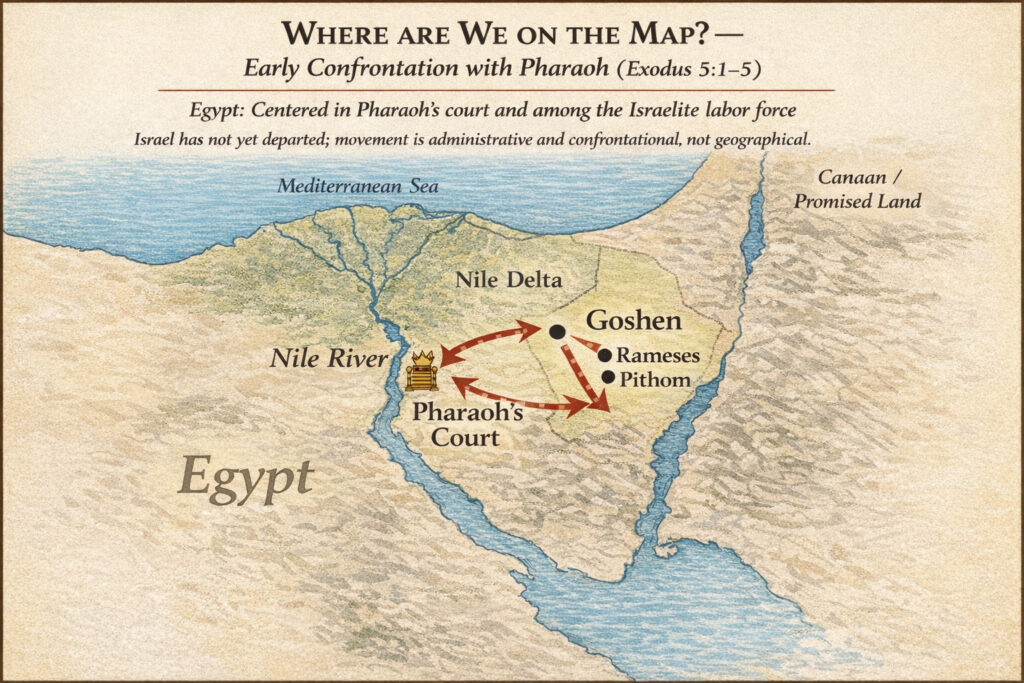
Where Are We on the Map?
- Egypt: Centered in Pharaoh’s court and among the Israelite labor force (Exod 5:1–5).
- Israel has not yet departed; movement is administrative and confrontational, not geographical.
Where Are We in God’s Program? (Dispensational)
- God formally invokes the Abrahamic Covenant promises of deliverance and inheritance (Exod 6:2–8; Gen 15:13–14).
- Israel remains under Gentile dominion, but divine judgment is about to begin.
- God establishes Moses as His spokesman and Aaron as prophet (Exod 7:1).
Why This Matters
- God identifies Himself by His covenant name and acts in faithfulness to His promises (Exod 6:2–3).
- Human authority resists God’s word, setting the stage for judgment (Exod 5:2; 7:3–4).
How This Reading Relates to What Follows
- Pharaoh’s resistance necessitates escalating signs and judgments (Exod 7:14–25).
- The conflict will move from words to acts of divine power before all Egypt.
Summary Orientation
- God asserts His authority through His chosen mediator.
- Pharaoh hardens his heart in open defiance.
- The confrontation that will lead to Israel’s redemption formally begins.
Coming soon…